
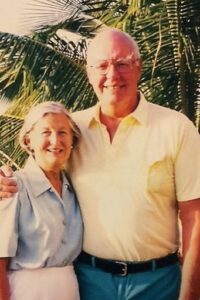
Alan Rudolph Krasberg
On March 14, 2026, at age 91, Alan R. Krasberg died peacefully in his home on Smith Mountain Lake surrounded by family, exactly the way this fiercely independent man would have wanted it.Al Krasberg was one of a kind: renowned scientist, inventor, theoretician, explorer, master diver, astrophysicist. To the world, he is best known for his advancements in the field of commercial diving and his groundbreaking work in the field of “saturation diving.” But to his family he was all that and much more.To Al’s parents, Harry and Camilla Krasberg, Al was their precocious son whose genius they fostered by allowing him to take University classes while still insisting that he remain in regular high school. To his wife, Patricia Krasberg (who died in 2009), Al was a devoted husband for 45 years. While Al was the eccentric inventor, Tish was the levelheaded one who kept him grounded. To Al’s two children, Mark and Lisa Krasberg (and Lisa’s husband Tim Jester), Al was an indomitable force of nature. When Al set his mind on something, it was best to just get out of his way; even at age 90, clad in a wetsuit, Al was still swimming in – and across – Smith Mountain Lake. Mark and Lisa were both with Al at the end, along with his niece Susie Krasberg and her husband Mark Bowen.Al graduated from the University of Illinois and received his Master’s from Harvard in mathematics and astrophysics. But Al always had a special love for all things ocean-related. As an avid recreational diver and snorkeler, Al had the rare ability to snorkel deeper than 100 feet, a skill he put to use during summer jobs harvesting sea sponges from the ocean floor, spearfishing, or salvaging shipwrecks (he once attempted to bring up the 600-pound safe from the sunken ocean-liner Andrea Doria in 250 feet of water). He had a particular interest in developing ways to enable commercial divers to dive deeper, safer and longer. At 13, Al built an oxygen rebreather out of old air force parts. During the Korean War, Al was an army photographer and conducted underwater body recovery. As a 26-year-old graduate student at Harvard, Al invented a closed-circuit portable device that he built in his basement and ultimately sold to the US Navy. The July 1965 edition of the magazine Popular Mechanics profiled Al’s “revolutionary” scuba invention as possibly “the most important advance in diving since the invention of the air pump.” Al was a reserved and modest man who never discussed his many patents, numerous honors, or industry awards. Even his children did not know until well into adulthood that Al was Maryland’s 1966 Distinguished Young Scientist of the Year.In 1965, Al embarked on a project with Westinghouse Underseas Division that would forever change deep-sea diving. That project, which was the first application of Al’s saturation diving techniques to commercial diving, took place at Smith Mountain Dam in Virginia.After four decades of preparation and work, and at the cusp of completion, the Smith Mountain Dam project went off the rails in the summer of 1965. When the power company, APCO, fired up the dam’s electricity-generating turbines for the very first time, enormous amounts of debris and refuse in the valley swept down toward the dam. The debris crashed into the trash gates that protected the turbines, jammed the intakes and rendered the new turbines completely useless. The power company faced two bad options. It could spend four years draining the lake, cleaning the gates, and refill the lake; another multi-year delay and millions of additional dollars seemed out of the question, though. The other option was to hire a team of commercial divers to clean out the debris, make the necessary repairs and get the system back online. But at the 200-foot depths they would have to work at, the divers would only be able to work in the dark, dangerous environment for a few minutes a day to avoid the bends. It was estimated that this second option would take the divers two years to complete the job, with no guarantee of success.Facing these bleak options, a member of the dam project brought up Al Krasberg’s saturation diving work in Massachusetts, which back in 1965 was still only a theoretical way to allow divers to work safely at much greater depths and for much longer periods of time. Westinghouse Underseas Division was hired for the project using Al’s as-yet untested saturation diving techniques, which included developing dive tables that required divers to spend over a week decompressing in a chamber. On Christmas Eve 1965, after only three months, Al and Westinghouse had completed the job. The Smith Mountain Dam project became the world’s first successful commercial saturation diving project.In March 1999, The Roanoker published an article entitled “The Men Who Saved Smith Mountain Lake and Changed the World,” detailing the history-making Smith Mountain Dam project and Al’s essential role in saving the massive project from failure.In the 1970s, Al moved with his family to Scotland, where the deep underwater oilfields in the North Sea could only be developed with the use of his saturation diving techniques. In Scotland, Al founded General Diving Systems, specializing in the design and manufacture of equipment for deep-sea commercial diving and exploration. There, working with Tish, he continued to invent new technologies that advanced his field. Over the ensuing decades, his patented rebreather system, the Return Line Diving System, took Al and Tish all around the world: China, Finland, Russia, Brazil, Malaysia, Norway and Sweden. His equipment and his dive tables were used throughout the world in the development of new oil and gas fields which were previously too deep for divers to work in. Commercial diving is one of the most dangerous jobs in the world, and when a diver anywhere in the world had a dive-related medical emergency, Al was often one of the first people called for advice.After eighteen years in Scotland, Al and Tish returned to the United States in 1989. After travelling the globe, Al and Tish chose to settle down at the scene of his first success that had revolutionized deepsea diving: Smith Mountain Lake. There, and also at a second home in the Florida Keys, Al’s underwater adventures continued for decades. When Al’s lake community of neighbors were notified that he had died, the email noted: “We will all miss seeing Al’s swim cap faithfully scooting across the lake.” With all the friends and neighbors he got to know over his decades at Smith Mountain Lake, Al even had a few above-ground adventures too!In lieu of flowers, donations may be made to the Scruggs Volunteer Fire & Rescue (SVFR) or to Carilion Hospice of Franklin County, whose staff provided such tender and loving care to Al and his family in his final weeks. Al’s family would also like to thank the outstanding caregivers from Thriving Well at Home who cared for him with compassion and skill over his last three months. Finally, the family would like to acknowledge Al’s wonderful caregiver Sierra Hodges, who became part of the family over her three years caring for Al but who tragically died in December 2025 at age 27.Arrangements by Conner-Bowman Funeral Home & Crematory, 62 VA Market Place Drive, Rocky Mount, VA 24151.